Rankian Psychology and Analysis of Military Leadership
✍️ Dr M.Anwar Professor, Department of Psychology, Mukkabir University of Science and Technology, Gujrat
📅 2026-07-19 17:39:16
ABSTRACT
Otto Rank’s Will Psychology offers a unique framework for understanding military leadership. Moving beyond Freud’s focus on Instinct and Repression, Rank identified Separation as the central human trauma and Will as the courage to create meaning despite anxiety. This article analyzes military leadership through a Rankian lens and argues that the ideal officer embodies sacrificial Separation, Will-driven purpose, therapeutic relationship, and faith-anchored meaning. Key military qualities, including leading from the front, mentorship, standard of excellence, altruism, trust, justice, and comradeship, are mapped onto Rank’s concepts of individuation, Will to merge vs individuate, and transformation of anxiety into creation. The case of Group Captain Asim Tariq Shaheed (July 2026) is an illustration of Rankian leadership in practice. The study concludes that modern armed forces require "Rankian Officers", as leaders who transform the anxiety of separation into honour, security, and mission success. This framework has implications for leadership development, training, and ethos in military organizations.
Keywords: Otto Rank, Will Psychology, Military Leadership, Separation-Individuation, Heroic Act, Sacrifice, Pakistan Armed Forces.
Introduction
Military leadership is not a rank of glittering stars on the shoulder. It is a psychological contract in which the military officer makes a firm promise: "Your life matters more than my comfort." This ideal aligns strikingly with the work of Otto Rank (1884–1939), the psychoanalyst who broke from Sigmund Freud to build "Will Psychology."
For Rank, the central human problem is not instinct, but separation - the awareness that we are ultimately alone and must create our own meaning (Rank, 1924/1936). According to Rankian psychology, the central human solution is not repression, as asserted by Freud, but Will - the courage to create meaning despite anxiety (Rank, 1936). In the military, the anxiety of separation is constant, and the Will to create meaning is tested daily. The officer who leads from the front, in Rankian terms, is the modern hero.
Main Contours of Rankian Psychology
1. Separation-The Core Concept
Separation is the central concept in Rankian psychology. Rank asserted that separation is the first trauma of birth and every later experience of individuation (Rank, 1924/1936). Rank identified the following layers of separation:
a. Biological Separation
Referred to as Birth Trauma, it is the violent cutting away from the mother at birth. Before birth, there is total safety, warmth, and union with the mother — no anxiety. At birth, sudden ejection into cold, air, light, and aloneness results in the prototype of all anxiety. Every fear, neurosis, and need for meaning later in life is an attempt to resolve this first separation anxiety (Rank, 1924/1936).
b. Psychological Separation: Individuation
After birth, we keep re-enacting the separation throughout our whole lives. This leads to individuation. Rank asserted that separation is the process of becoming an individual distinct from others, especially from the mother figure. Examples include a child going to school for the first time; an adolescent leaving home; an adult choosing a path different from family expectations; or a leader stepping forward alone to take responsibility. This creates separation anxiety and a tension between two opposing forces:
(1) Will to Merge. Go back to safety, comfort, and belonging.
(2) Will to Individuate. Move forward, be free, and create something new (Rank, 1936).
Healthy individuals balance both the opposing forces. Unhealthy individuals collapse to one side, either total dependence or total isolation.
c. Existential Separation: The Final Cut
Rank said the deeper separation is from life itself and embracing death.
Thus, separation is the awareness that we are ultimately alone and must create our own meaning. The artist, the hero, and the leader do not run from this. They use it (Rank, 1936)
Separation in Military Leadership Context
Rank said military separation has the following dimensions: -
(1) Physical. Leaving family, comfort, and home to perform duty.
(2) Responsibility. Military officer sleeping separately during operations and outdoor exercises, making decisions alone and owning the mission.
(3) Moral. Standing apart from the crowd to do what is right, even at personal cost.
(4) Anxiety of Responsibility and Use of Will. A weak leader avoids separation by merging with comfort and avoiding responsibility. A Rankian officer embraces separation. He feels the anxiety of responsibility and uses his Will to turn it into protection for his men and the accomplishment of the mission.
(5) Rank’s Final Word on Separation and Use of Will. Rank summarized: "Separation is the painful price of individuality. Will is the courage to pay that price and create meaning anyway."
*2. Will: The Engine of Command *
Rank rejected the idea that humans are only driven by past trauma. He argued that we are driven forward by Will - to individuate, to create, and to become (Rank, 1936). The military officer works for the cause, rejects self-interest, and completes the assigned mission at any cost. He dislikes being a conscript but fulfils his duty with a passion for altruism.
The Will in Uniform. The military officer does not wait for motivation. He generates it. His purpose is supreme. Comfort, safety, and personal interest are secondary. The mission becomes the act of creation that transforms anxiety into achievement. Training to achieve a standard of excellence is the discipline of Will. It is the refusal to accept "good enough," especially when men's lives depend on it.
3. Separation and Individuation at the Point of Danger: Leading from the Front
Rank’s core trauma was birth: the painful separation from (mother) safety into the world. All leadership re-enacts this. The officer sleeps separately from his men but carries serious concerns for them. His speed is that of the slowest member of his team.
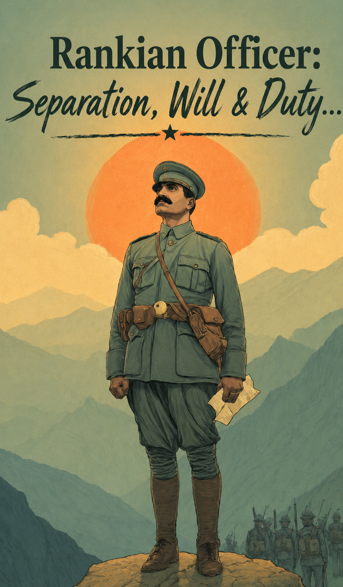
The officer must separate to carry responsibility, make hard decisions, and remain accountable. Yet he must merge in purpose, hardship, and risk. He does not command from behind. He individuates himself at the point of danger so his men do not have to face it alone. This is not isolation. This is sacrificial separation - the highest form of Rankian individuation.
The Therapeutic Relationship Connecting Military Leadership Traits
a. Trust, Respect, and Mentorship. Rank revolutionized therapy by stating that the relationship itself heals. Authority without connection is empty (Rank, 1945). The military officer is kind, easy to approach, and a fair and just decision maker. He practices mentorship, and in military service, senior leadership grooms the juniors. Trust is strong and high. Mutual respect and a sense of comradeship bind the entire unit.
b. The Modern Officer is not a Distant Commander. He is a mentor. He builds people and does not just make operational plans. By keeping his interests impersonal, he proves his judgments are just. By fulfilling promises, he builds trust that becomes combat power. Comradeship is the unit’s answer to Rank’s "Will to Merge" - we survive because we belong to each other.
c. Transforming Anxiety into Honor: The Heroic Act. For Rank, neurosis is failed creativity. The artist and the hero turn anxiety into something higher (Rank, 1932). The officer is courageous, faces challenges, and owns responsibility. The safety and well-being of troops is the top priority.
"A military leader is selfless, committed, always ready to sacrifice his comfort, safety, and life for his men and for the cause." Every deployment, every difficult decision, and every risk is a moment of Rankian creation. The officer takes the raw material of fear, separation, and hardship, and forges honour, security, and mission success. This is why human values and the honour of serving become the hallmarks of military leadership. Without them, sacrifice becomes meaningless. With them, sacrifice becomes legacy.
d. The Spiritual Dimension: Faith as the Ultimate Will. Rank spoke of Will, but he also spoke of meaning. In this context, the meaning of faith is anchored. "The military officer has strong faith in Allah." Faith provides the ultimate frame for Rankian Will. It answers: For what am I separating from safety? For what am I risking myself? When purpose is supreme and anchored in faith, duty becomes worship. The willingness to die for others becomes the highest form of trust in Allah’s plan. The officer does not fear separation from life because he trusts the One (Allah SWT) who gives it.
Conclusion: The Rankian Ethos for Armed Forces
Otto Rank would not have described a soldier as driven by instinct. He would have described him as driven by Will to create safety for others. The Rankian officer therefore embodies: Will over comfort- mission first; sacrificial separation - leading from the front; relationship - mentorship, trust, respect, and justice; creation - turning hardship into excellence and honour; and faith - anchoring purpose beyond self.
Group Captain Asim Tariq Shaheed demonstrated this at Shaheen Chowk (July 2026). He separated from safety, exercised Will, and created protection for a stranger. He paid the ultimate price, but he proved the Rankian truth: A leader’s greatness is measured not by what he commands, but by what he is willing to give. In an era of social disorder, we do not need more managers in uniform. We need more Rankian Officers - men and women of Will, who train for excellence, mentor the next generation, decide fairly, and never forget that purpose is supreme.
"The standard you walk past is the standard you accept." The Rankian officer refuses to walk past.
REFERENCES
Rank, O. (1932). Art and artist: Creative urge and personality development (C. F. Atkinson, Trans.).
Alfred A. Knopf. (Original work published 1932)
Rank, O. (1936). Will therapy (J. Taft, Trans.). Alfred A. Knopf. (Original work published 1936)
Rank, O. (1945). The psychology of difference: The American lectures (R. Kramer, Ed.). Princeton University Press.
Rank, O. (1993). The trauma of birth (D. Feider, Trans.). Dover Publications. (Original work published 1924)